
Corporate earnings from blue-chips like HDFC Bank, ICICI Bank, Donald Trump's swearing-in as the US President, and trading activity of foreign investors are the key factors to drive equity markets this week, analysts said. Trump will be sworn in as the US president for a second term on Monday. This week, several key Nifty-50 companies, including BPCL, HDFC Bank, Hindustan Unilever, Dr Reddy's, UltraTech Cement, JSW Steel and ICICI Bank are scheduled to announce their financial results.

From the 30-share Sensex pack, Adani Ports surged nearly 6 per cent. NTPC, Axis Bank, State Bank of India, Larsen & Toubro, UltraTech Cement, Tata Motors, HDFC Bank and Reliance Industries were the other big gainers. Bharti Airtel, ITC, Sun Pharma, Asian Paints and Kotak Mahindra Bank were the laggards.

Highly-rated finance firms and housing finance companies are expected to benefit from the absence of Housing Development Finance Corp (HDFC) from the bond market once it merges with the HDFC Bank in early FY24. Post merger, the bond market is expected to become less crowded, which will ease fund raising conditions for other players in the field. It may perhaps also compress the spread for debt instruments floated by housing finance companies (HFCs) over 10-year government bonds, subject to demand and supply conditions.

Billionaire Mukesh Ambani's Reliance Industries has retained its position as the highest-ranked Indian company on the 2025 Fortune Global 500 list, according to the latest rankings released by the publication. The oil-to-telecom-and-retail conglomerate has been ranked at No.88 on the latest list, down from 86th position in 2024.

From the Sensex pack, HCL Tech, Infosys, Tech Mahindra, Reliance Industries, Bajaj Finserv, ICICI Bank, Tata Motors and Eternal were the lead gainers. Power Grid, Adani Ports, IndusInd Bank, Nestle, HDFC Bank and Hindustan Unilever were among the laggards.

India Inc, which is sitting on cash balances of 13.5 trillion, is using the funds to meet capital expenditure as well as brownfield expansion, resulting in 'anaemic' demand for bank loans, State Bank of India (SBI) chairman CS Setty said at an event on Monday. He added that a slowdown in corporate credit is mainly due to lack of demand.

Equity benchmark indices Sensex and Nifty rebounded sharply on Monday after five days of steep decline amid value buying at lower levels and a rally in global markets. Besides, hectic buying in blue-chip stocks ITC, HDFC Bank and Reliance Industries also helped in market recovery.
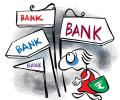
Investors should view any bounce-back in bank stocks as an opportunity to exit the pack, analysts suggested, as the worst may not be over yet. The recent quarterly results of HDFC Bank and Axis Bank disappointed the Street, triggering a marketwide selloff by foreign institutional investors, especially in banking counters. While HDFC Bank, which was the anchor for the market correction during the past week, ended 2 per cent higher amid short covering on Wednesday, Axis Bank's shares settled 3 per cent lower.

Among Sensex firms, Tech Mahindra, HCL Tech, Eternal, Axis Bank, Maruti, Tata Steel, HDFC Bank and Asian Paints were the gainers. However, Adani Ports, Trent, Tata Motors, Hindustan Unilever and NTPC were among the laggards.

Early-bird results for the January-March 2025 quarter (Q4FY25) suggest a slowdown in earning growth for India Inc, despite a benign cost environment that has led to an improvement in margins. The combined net profit (adjusted for exceptional gains and losses) of 175 early-reporting companies rose by 3.8 per cent year-on-year (Y-o-Y) in Q4FY25, marking the slowest growth in 17 quarters.
Shares of ICICI Bank may outperform those of HDFC Bank in the near-term, analysts said recently, after the Sandeep Bakhshi-led private sector lender reported a strong set of numbers for the July to September quarter (Q2) of financial year 2023-24 (FY24). The result, they said, reiterated that ICICI Bank is maintaining a sustainable and prudent growth led by tech-driven initiatives as against HDFC Bank, which is facing merger related challenges. According to analysts at Prabhudas Lilladher, ICICI Bank is valued at par with HDFC Bank at 2.2x/1.9x on FY25/26E core adjusted book value (ABV) basis.

As the fight for deposits intensifies, the cost of money will rise and the margin will be under further pressure, points out Tamal Bandyopadhyay.

From the 30-share Sensex pack, Infosys, ICICI Bank, Kotak Mahindra Bank, Mahindra & Mahindra, State Bank of India, HCL Technologies, Axis Bank, NTPC and HDFC Bank were among the laggards. In contrast, Maruti, IndusInd Bank, Adani Ports, ITC and UltraTech Cement defied broader market trends and ended in positive territory.
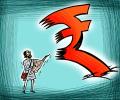
The rupee plunged 26 paise to an all-time low of 90.75 against the US dollar in intra-day trade on Monday, weighed down by uncertainty over an India-US trade deal and persistent foreign fund outflows.
Banks have issued Rs 7.78 trillion worth of CDs in the current calendar year until August 2024, compared to Rs 4.9 trillion in the same period of 2023, registering a 59 per cent growth

HDFC Bank had opened multiple demand accounts which were used for manipulation of the IPO allotment process in the last few years, but those were not held in benami names.

Last fortnight, State Bank of India Chairman C S Setty lifted the veil on a subject long spoken of in corporate corridors: Why can't our banks finance mergers and acquisitions (M&As)? Change is in the air: Indian Banks' Association (of which Setty is the chairman) is to "make a formal request" to Mint Road to make way for it. Thus far the exclusive turf of foreign banks even though its funding remains offshore - as in, it's not on these entities rupee-book (and a few select shadow banks) - a most lucrative segment in the investment banking suite, M&As, will be homeward-bound.

The bottom lines of several private sector banks have taken a hit following the recent guidelines released by the Reserve Bank of India (RBI) on alternate investment fund (AIF) investments. Last month, the RBI announced that regulated entities, such as banks, non-bank lenders, and home financiers, cannot invest in AIFs that have directly or indirectly invested in companies that have borrowed money from the lenders. In case an entity had already made such an investment, they must liquidate the investment or make 100 per cent provision, RBI had said.

Gold prices dropped by Rs 4,100 to Rs 121,800 per 10 grams in the national capital and slipped below $4,000 an ounce in the global markets on Tuesday as easing US-China trade tensions dampened safe-haven appeal. According to the All India Sarafa Association, the precious metal had closed at Rs 125,900 per 10 grams on Monday.

Sensex sinks 573 pts on global tensions and high crude prices
From the Sensex pack, State Bank of India, HDFC, Axis Bank, HDFC Bank, Bharti Airtel, Kotak Mahindra Bank, ICICI Bank, Tata Motors, NTPC and Bajaj Finserv were the major gainers.

Analysts say domestic banks' dependence on local depositors insulates them from the crisis.
Titan, HCL Tech and State Bank of India were also among the laggards. However, Hindustan Unilever, Asian Paints, ICICI Bank, Power Grid, HDFC Bank and ITC were the gainers.
Among Sensex firms, Tech Mahindra, HCL Tech, Asian Paints, NTPC, Infosys, Nestle, Sun Pharma, and Tata Steel were the major laggards. Eternal, State Bank of India, HDFC Bank, Larsen & Toubro, Reliance Industries and Bajaj Finserv were the gainers.

Unidentified men posing as central government officials intercepted a cash van in Bengaluru and allegedly fled with about Rs 7 crore. Police are investigating the incident and have formed teams to hunt for the suspects.

FDI rules announced last year changed the criteria of calculating these investments and included American depository receipts, global depository receipts and convertible shares also in that category.

The RBI said it had not found initial evidence of money laundering against the three banks.
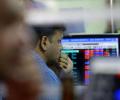
Key benchmark indices Sensex and Nifty declined for the third session in a row on Friday, dropping nearly 1 per cent, dragged by heavy selling in IT, auto and energy stocks. Tariff-related uncertainties amid mixed global market trends also added to the pressure, analysts said. The 30-share BSE Sensex tanked 689.81 points or 0.83 per cent to settle at 82,500.47.

Among Sensex firms, Eternal, Infosys, Asian Paints, HDFC Bank, Bajaj Finserv and Titan were the major gainers. However, Tata Steel, Tech Mahindra, Adani Ports and Bharat Electronics were among the laggards.

The more things change, the more they remain the same for corporate India. In the April-June 2025 period (Q1FY26) - for the ninth consecutive quarter - listed companies witnessed only single-digit revenue growth, while their core earnings, excluding other income and one-time gains, contracted for the second time in four quarters. This comes as firms brace for the impact of 50 per cent US tariff on Indian goods.
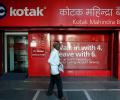
Kotak Mahindra Bank's net interest margin is likely to swell after the Reserve Bank of India (RBI) lifted its restrictions on the private lender that barred it from issuing fresh credit cards and onboarding new customers through digital mode, brokerages said on Thursday. The bank's net interest margin (NIM) has seen a decline of over 35 basis points (bps) since the restrictions were imposed by the regulator in April 2024.

The Indian equity markets will soon account for over a fifth of a key emerging market (EM) benchmark tracked by funds with assets exceeding $500 billion. This development is expected to funnel as much as $3 billion into the domestic markets. Following the latest review undertaken by global index provider MSCI, India's weighting in the MSCI EM index will surpass 20 per cent for the first time, narrowing its gap with the current top-weighted China to fewer than 400 basis points.
HDFC bank is planning to foray into investment banking soon and also strengthen its international presence.
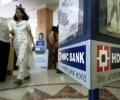
Mobile banking services is part of the bank's overall strategy to use convergent communication platform to engage with customers, senior executive vice-president for Direct Banking Channels and Premier Banking Birendra Sahu said in Indore.

From the 30-share Sensex pack, Mahindra & Mahindra, Tech Mahindra, HDFC Bank, Titan, Tata Motors, UltraTech Cement, Power Grid and Infosys were the biggest gainers. In contrast, Reliance Industries, State Bank of India, Bajaj Finserv, Maruti, Tata Steel and Bharti Airtel were among the laggards.

From the 30-share Sensex pack, Mahindra & Mahindra, Tata Steel, Adani Ports, JSW Steel, IndusInd Bank, Reliance Industries, HDFC Bank and Kotak Mahindra Bank were the biggest laggards. Tata Motors, NTPC, Hindustan Unilever, Asian Paints and Infosys were the gainers.
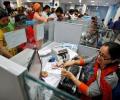
Commercial banks in India reported a sixth consecutive year of rise in their net profits in 2023-24 while bad loans continued to fall, according to the Reserve Bank of India's (RBI's) annual publication "Trends and Progress of Banking in India", released on Thursday. "Banks' profitability rose for the sixth consecutive year in 2023-24 and continued to rise in H1:2024-25 with the return on assets (RoA) at 1.4 per cent and return on equity (RoE) at 14.6 per cent," the report said.
From the 30-share Sensex blue-chip pack, Tata Steel, Zomato, Larsen & Toubro, Tata Motors, Adani Ports, Tata Consultancy Services, HDFC Bank and NTPC were the major laggards. Nestle, Hindustan Unilever, Mahindra & Mahindra, Kotak Mahindra Bank, Asian Paints and Bharti Airtel were among the gainers.

From the Sensex pack, Tech Mahindra, HDFC Bank, Larsen & Toubro, ITC, Infosys, IndusInd Bank, Kotak Mahindra Bank, Titan and HCL Technologies were among the gainers. Maruti Suzuki India, Tata Steel, Bajaj Finance, UltraTech Cement, Nestle India, Axis Bank and Tata Consultancy Services (TCS) were among the laggards.
